Openai/69590395-0448-8008-a9cf-189d43182e3b
This conversation was exported from ChatGPT[1]
![1.2.1.1 !https://i\.guim\.co\.uk/img/static/sys\-images/Guardian/Pix/pictures/2006/09/21/chavezUNchom\_372\.jpg?crop=none&dpr=1&s=none&width=465[5]](#!https://i%5C.guim%5C.co%5C.uk/img/static/sys%5C-images/Guardian/Pix/pictures/2006/09/21/chavezUNchom%5C_372%5C.jpg?crop=none&dpr=1&s=none&width=465%5B5%5D)
![1.2.1.2 !https://npr\.brightspotcdn\.com/dims4/default/303672e/2147483647/strip/true/crop/5422x3615%2B0%2B0/resize/880x587%21/quality/90/?url=http%3A%2F%2Fnpr\-brightspot\.s3\.amazonaws\.com%2F71%2F9a%2Fa8c6c6574b78bfdffe90c42bc10a%2Faptopix\-venezuela\-maduro\-rally\-25344723501248\.jpg[8]](#!https://npr%5C.brightspotcdn%5C.com/dims4/default/303672e/2147483647/strip/true/crop/5422x3615%252B0%252B0/resize/880x587%2521/quality/90/?url=http%253A%252F%252Fnpr%5C-brightspot%5C.s3%5C.amazonaws%5C.com%252F71%252F9a%252Fa8c6c6574b78bfdffe90c42bc10a%252Faptopix%5C-venezuela%5C-maduro%5C-rally%5C-25344723501248%5C.jpg%5B8%5D)
![1.2.1.3 !https://www\.chevron\.com/\-/media/chevron/worldwide/images/updated\_venuzuela\_hero\_img\.jpg?h=882&hash=A78EC32E7DB94D5B26250EE05311D493&la=en&w=1568[11]](#!https://www%5C.chevron%5C.com/%5C-/media/chevron/worldwide/images/updated%5C_venuzuela%5C_hero%5C_img%5C.jpg?h=882&hash=A78EC32E7DB94D5B26250EE05311D493&la=en&w=1568%5B11%5D)
gpt-5-2 edit
User: what do you know about the us and venezuela? edit
what do you know about the us and venezuela?
Assistant: The relationship between the United States and Venezuela is a long, complicated mix of cooperation, conflict, ideology,… edit
The relationship between the United States and Venezuela is a long, complicated mix of cooperation, conflict, ideology, and oil politics. Here’s a clear, structured overview—historical, political, economic, and where things stand today.
### edit
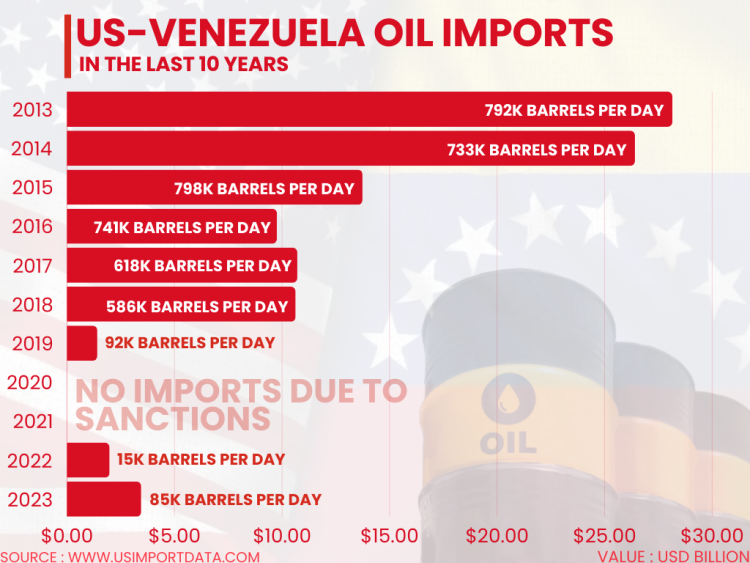
!https://upload\.wikimedia\.org/wikipedia/commons/5/55/Venezuela\_historic\_inflation\_index\_and\_oil\_revenue\.png[2] !https://www\.usimportdata\.com/blogs/uploads/images/202412/image\_750x\_6752cd205b3b1\.png[3] !https://cdn\.britannica\.com/76/72976\-138\-55EFC1D3/Caracas\-Venezuela\.jpg[4]


- For much of the 20th century, relations were pragmatic and cooperative.
- Venezuela was: - One of the world’s major oil exporters - A stable democracy (after 1958) - A key supplier of oil to the US
- US companies (Exxon, Chevron, etc.) had major investments in Venezuelan oil.
In short: oil + anti-communist alignment = good relations.
!https://i\.guim\.co\.uk/img/static/sys\-images/Guardian/Pix/pictures/2006/09/21/chavezUNchom\_372\.jpg?crop=none&dpr=1&s=none&width=465[5] edit

!https://www\.gainesville\.com/gcdn/authoring/2007/11/17/NTGS/ghows\-LK\-717c4cde\-9a4b\-46e6\-b192\-ba46797d0699\-da380531\.jpeg?auto=webp&disable=upscale&format=pjpg&width=1200[6] !https://cdnuploads\.aa\.com\.tr/uploads/Contents/2019/02/02/thumbs\_b\_c\_6bf49567e3c2f9d2f42986bb98d58566\.jpg?v=225900[7]


- Hugo Chávez came to power in 1999.
- He launched the “Bolivarian Revolution”: - Socialist ideology - Strong anti-US rhetoric - Nationalization of oil and key industries
- Chávez positioned Venezuela as: - A leader of anti-US, anti-imperialist politics - Ally of Cuba, Iran, Russia, China
US perspective:
- Concern over: - Democratic backsliding - Nationalization of US assets - Regional influence against US interests
From here on, relations steadily deteriorated.
!https://npr\.brightspotcdn\.com/dims4/default/303672e/2147483647/strip/true/crop/5422x3615%2B0%2B0/resize/880x587%21/quality/90/?url=http%3A%2F%2Fnpr\-brightspot\.s3\.amazonaws\.com%2F71%2F9a%2Fa8c6c6574b78bfdffe90c42bc10a%2Faptopix\-venezuela\-maduro\-rally\-25344723501248\.jpg[8] edit

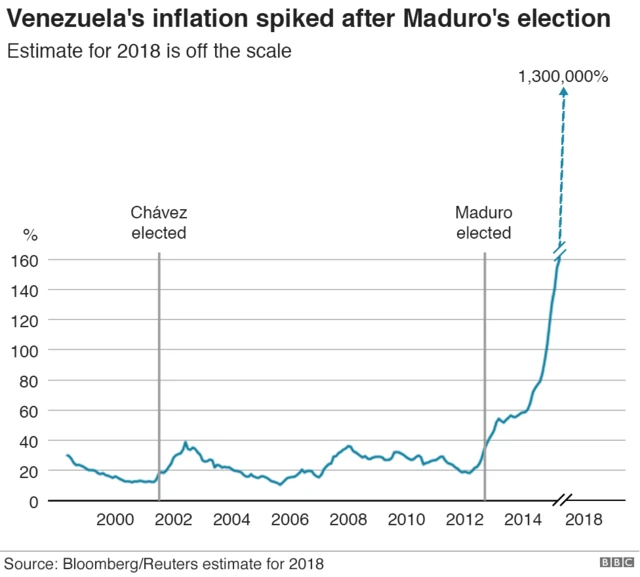
!https://ichef\.bbci\.co\.uk/ace/ws/640/cpsprodpb/7822/production/\_105345703\_venezuela\-inflation\_v3\_976\-nc\.png\.webp[9] !https://www\.brookings\.edu/wp\-content/uploads/2018/04/global\_venezuelanrefugees\_colombianborder\.jpg[10]


- After Chávez’s death, Nicolás Maduro took over.
- Venezuela experienced: - Economic collapse (hyperinflation, shortages) - Mass emigration (7–8 million people) - Accusations of authoritarianism and electoral fraud
US response:
- Sanctions on: - Venezuelan oil - State institutions - Key individuals
- Recognition (2019) of opposition leader Juan Guaidó as interim president (no longer active now)
Venezuela’s response:
- Deeper ties with Russia, China, Iran
- Framing the crisis as US economic warfare
!https://www\.chevron\.com/\-/media/chevron/worldwide/images/updated\_venuzuela\_hero\_img\.jpg?h=882&hash=A78EC32E7DB94D5B26250EE05311D493&la=en&w=1568[11] edit

!https://www\.miamiherald\.com/public/latest\-news/na3su5/picture299541614/alternates/LANDSCAPE\_1140/Richard%20Grenell%20at%20Miraflores\.jpg[12] !https://cdn\.cfr\.org/sites/default/files/styles/immersive\_image\_3\_2\_desktop\_2x/public/image/2019/01/Opec\.webp[13]


Despite hostile rhetoric, reality is more nuanced:
- US sanctions hurt Venezuela badly, but: - Internal mismanagement and corruption were also central causes
- After Russia’s invasion of Ukraine, the US: - Quietly allowed limited oil cooperation - Gave Chevron partial licenses to operate in Venezuela
- The US goal shifted from “regime change” to: - Preventing humanitarian collapse - Managing migration - Stabilizing oil markets
So the relationship today is hostile in principle, pragmatic in practice.
US view of Venezuela edit
- An authoritarian state
- A source of: - Regional instability - Migration pressure - Influence from US rivals (Russia, China)
Venezuelan government view of the US
- An imperial power
- Responsible for: - Sanctions - Economic hardship - Attempts to overthrow the government
Both narratives contain partial truths.
- This is not just a bilateral dispute. edit
- It sits at the intersection of: - Energy politics - Ideology (socialism vs liberal democracy) - Global power competition
- Neither side fully trusts the other, but neither can completely disengage.
If you’d like, I can:
- Compare Venezuela with Cuba or Iran in US foreign policy
- Explain sanctions mechanics in plain terms
- Discuss whether Venezuela could realistically recover—and under what conditions
- Frame this from a global South or non-US-centric perspective
Just tell me which angle you’re curious about.
User: What can ousting of maduro help the us stance economially and politically? edit
What can ousting of maduro help the us stance economially and politically?
Assistant: Ousting Nicolás Maduro could theoretically help the United States in several economic and political ways—but it’s impor… edit
Ousting Nicolás Maduro could theoretically help the United States in several economic and political ways—but it’s important to separate potential benefits, realistic limits, and risks. I’ll be frank and non-romantic about it.
1. Economic implications for the US edit
✅ What the US could gain edit
- Oil market access and stability
- Venezuela has the world’s largest proven oil reserves.
- A post-Maduro government acceptable to Washington would likely: - Reopen fully to US companies (Chevron, Exxon, service firms) - Restore Venezuelan production over time
- This would: - Add non-Russian, non-Middle Eastern supply - Reduce global price volatility - Strengthen US energy security indirectly
Reality check: This would take years, not months. Venezuela’s infrastructure is badly damaged.
- Reduced sanctions-management costs
- Sanctions are expensive to enforce diplomatically and administratively.
- A friendly government would allow: - Removal of oil and financial sanctions - Normal banking and trade channels
- That benefits US firms and financial institutions.
- Migration pressure
- Venezuela’s collapse has sent millions of migrants across the region, some to the US.
- Economic recovery under a new government could: - Slow outbound migration - Reduce US domestic political pressure on immigration
❌ What the US would not gain edit
- Venezuela would not suddenly become an oil bonanza for the US.
- China and Russia would not disappear from Venezuela overnight.
- Oil prices would still be influenced mainly by OPEC+ and global demand.
2. Political and strategic implications edit
✅ Strategic advantages edit
- Symbolic win for US democracy promotion
- Removing Maduro would be seen (in Washington) as: - A rollback of authoritarian socialism in the hemisphere - A counterexample to Cuba-style endurance
- This matters especially in US domestic politics and foreign-policy signaling.
- Reduced influence of US rivals
Maduro is closely aligned with:
- Russia (security, oil)
- China (debt, infrastructure)
- Iran (sanctions evasion)
A new government would likely:
- Rebalance away from these actors
- Reduce their strategic foothold in the Americas
- Regional diplomatic reset
- Latin American governments are divided on Venezuela.
- A credible transition could: - Reduce regional polarization - Improve US relations with moderate governments in the region
❌ Political limits edit
- US credibility is mixed in Latin America due to: - Past interventions - Sanctions harming civilians
- Any government seen as “installed by the US” would face legitimacy problems.
- Nationalism would still constrain close alignment with Washington.
3. The biggest risks for the US edit
⚠️ 1. Chaos instead of transition edit
- Ousting Maduro without a strong institutional plan could produce: - Power vacuum - Military fragmentation - Competing armed groups This would be worse for US interests than the status quo.
⚠️ 2. Anti-US backlash edit
- Many Venezuelans oppose Maduro and distrust the US.
- If sanctions are remembered more than relief, resentment could persist.
⚠️ 3. Setting a precedent edit
- Regime change narratives weaken US arguments elsewhere: - Against Russia (Ukraine) - Against China (Taiwan, Hong Kong)
- It complicates the global norm of sovereignty.
4. Bottom line (plain assessment) edit
From a US perspective:
- Economically → moderate long-term upside
- Politically → symbolically significant but operationally limited
- Strategically → useful only if stable, legitimate, and gradual
The uncomfortable truth: For the US, a slow normalization under negotiated reforms may be better than a dramatic ousting that risks instability.
That is why current US policy quietly leans toward:
- Conditional sanctions relief
- Negotiated elections
- Managed coexistence, not invasion or abrupt regime change
If you want, next we could explore:
- Why regime change worked in some cases (e.g. Eastern Europe) but not others
- Whether Venezuela is closer to Iran, Cuba, or Myanmar as a case
- How China would actually respond to a post-Maduro Venezuela
- Or assess this from a global South / non-US lens
Just point me to the angle you care about most.
References edit
- ↑ "US Venezuela Relations". ChatGPT. Retrieved 2026-01-04.
- ↑ "https://upload\.wikimedia\.org/wikipedia/commons/5/55/Venezuela\_historic\_inflation\_index\_and\_oil\_revenue\.png". upload.wikimedia.org. Retrieved 2026-01-04.
{{cite web}}: External link in|title= - ↑ "https://www\.usimportdata\.com/blogs/uploads/images/202412/image\_750x\_6752cd205b3b1\.png". usimportdata.com. Retrieved 2026-01-04.
{{cite web}}: External link in|title= - ↑ "https://cdn\.britannica\.com/76/72976\-138\-55EFC1D3/Caracas\-Venezuela\.jpg". cdn.britannica.com. Retrieved 2026-01-04.
{{cite web}}: External link in|title= - ↑ "https://i\.guim\.co\.uk/img/static/sys\-images/Guardian/Pix/pictures/2006/09/21/chavezUNchom\_372\.jpg?crop=none&dpr=1&s=none&width=465". i.guim.co.uk. 2006-09-21. Retrieved 2026-01-04.
{{cite web}}: External link in|title= - ↑ "https://www\.gainesville\.com/gcdn/authoring/2007/11/17/NTGS/ghows\-LK\-717c4cde\-9a4b\-46e6\-b192\-ba46797d0699\-da380531\.jpeg?auto=webp&disable=upscale&format=pjpg&width=1200". images.openai.com. Retrieved 2026-01-04.
{{cite web}}: External link in|title= - ↑ "https://cdnuploads\.aa\.com\.tr/uploads/Contents/2019/02/02/thumbs\_b\_c\_6bf49567e3c2f9d2f42986bb98d58566\.jpg?v=225900". cdnuploads.aa.com.tr. 2019-02-02. Retrieved 2026-01-04.
{{cite web}}: External link in|title= - ↑ "https://npr\.brightspotcdn\.com/dims4/default/303672e/2147483647/strip/true/crop/5422x3615%2B0%2B0/resize/880x587%21/quality/90/?url=http%3A%2F%2Fnpr\-brightspot\.s3\.amazonaws\.com%2F71%2F9a%2Fa8c6c6574b78bfdffe90c42bc10a%2Faptopix\-venezuela\-maduro\-rally\-25344723501248\.jpg". npr.brightspotcdn.com. Retrieved 2026-01-04.
{{cite web}}: External link in|title= - ↑ "https://ichef\.bbci\.co\.uk/ace/ws/640/cpsprodpb/7822/production/\_105345703\_venezuela\-inflation\_v3\_976\-nc\.png\.webp". ichef.bbci.co.uk. Retrieved 2026-01-04.
{{cite web}}: External link in|title= - ↑ "https://www\.brookings\.edu/wp\-content/uploads/2018/04/global\_venezuelanrefugees\_colombianborder\.jpg". tse2.mm.bing.net. Retrieved 2026-01-04.
{{cite web}}: External link in|title= - ↑ "https://www\.chevron\.com/\-/media/chevron/worldwide/images/updated\_venuzuela\_hero\_img\.jpg?h=882&hash=A78EC32E7DB94D5B26250EE05311D493&la=en&w=1568". chevron.com. Retrieved 2026-01-04.
{{cite web}}: External link in|title= - ↑ "https://www\.miamiherald\.com/public/latest\-news/na3su5/picture299541614/alternates/LANDSCAPE\_1140/Richard%20Grenell%20at%20Miraflores\.jpg". miamiherald.com. Retrieved 2026-01-04.
{{cite web}}: External link in|title= - ↑ "https://cdn\.cfr\.org/sites/default/files/styles/immersive\_image\_3\_2\_desktop\_2x/public/image/2019/01/Opec\.webp". images.openai.com. Retrieved 2026-01-04.
{{cite web}}: External link in|title=