Openai/6944401e-07c8-800d-9890-76b35b1d919d
This conversation was exported from ChatGPT[1]
gpt-5-2[edit | edit source]
User: Do duplex septic pumps require both pumps to be operational?[edit | edit source]
Do duplex septic pumps require both pumps to be operational?
Assistant: Short answer: no—both pumps do not have to be operational for a duplex septic system to function, but it depends on how…[edit | edit source]
Short answer: no—both pumps do not have to be operational for a duplex septic system to function, but it depends on how the system is intended to operate.
Here’s how duplex septic pump systems are typically set up:
###[edit | edit source]
- Only one pump runs at a time
- Pumps alternate each cycle to equalize wear
- If one pump fails, the other can usually: - Keep the system operating on its own - Trigger an alarm indicating a pump failure
Result: ✔ System still works with one pump operational ⚠ Reduced redundancy until repaired
- One pump is the primary[edit | edit source]
- The second pump: - Starts only if liquid level rises unusually high - Or if the first pump can’t keep up
Result: ✔ Normal conditions: one pump is sufficient ✔ Peak flow: both pumps may be required
- Both pumps are designed to run together every cycle[edit | edit source]
- Used in: - Commercial systems - Large or high-head applications
Result: ❌ One pump alone may not meet design flow ⚠ System may alarm or fail to dose properly
- Alternating systems: usually no immediate failure, just loss of redundancy[edit | edit source]
- Lead/lag systems: alarms during heavy usage
- Simultaneous systems: potential overflow or inadequate dosing
Most systems will:
- Activate a high-water alarm
- Continue operating (if possible) until serviced
Look for:[edit | edit source]
- Control panel labels (alternating vs lead/lag)
- Float arrangement (separate lead/lag floats vs shared)
- Pump specs (flow/head requirements)
- Local code or engineer’s design documents
If you want, you can describe:
- The number of floats
- Whether the pumps run together or alternate
- Residential vs commercial system
and I can help you identify which configuration you have and whether one pump alone is acceptable.
User: there is an issue with this system overloading a generator on startup, we are trying to find a startup procedure that w…[edit | edit source]
there is an issue with this system overloading a generator on startup, we are trying to find a startup procedure that will let it run
Assistant: Got it — this helps a lot.[edit | edit source]
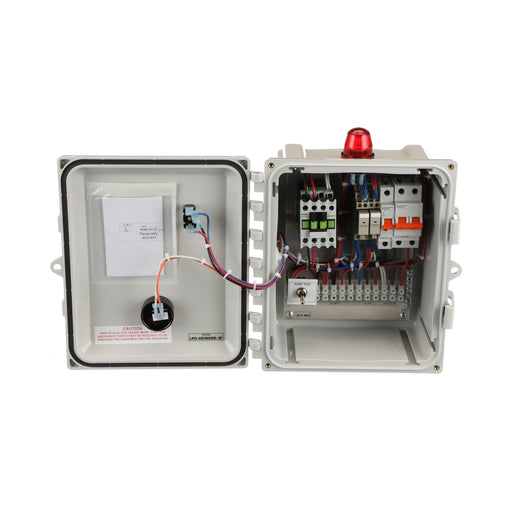
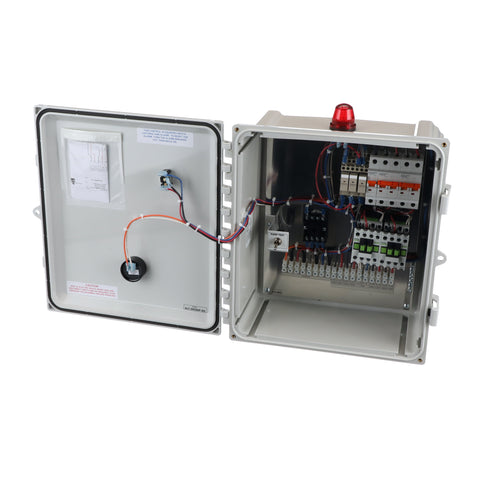
Got it — this helps a lot. Based on the panel photo and what you’re describing, this looks very much like a duplex pump system that can start both pumps together, which is exactly the kind of thing that will slam a generator on startup.
I’ll walk through what’s likely happening, then give you a practical startup procedure that usually works in the field.
!https://www\.wholesalesepticsupply\.com/cdn/shop/products/ALT\-DM2HP\-DV\_Control\_Panel\-01\-02\_4119aab6\-8464\-4f01\-94d5\-4babc36a0c59\_1200x1200\.jpg?v=1560439732&utm\_source=chatgpt\.com[2][edit | edit source]

!https://www\.wholesalesepticsupply\.com/cdn/shop/products/LPD\-G3E\_Control\_Panel\-01\-01\_fa4ea7b3\-345f\-4fba\-baa7\-024a8da034d2\_512x512\.jpg?v=1559762128&utm\_source=chatgpt\.com[3] !https://www\.wholesalesepticsupply\.com/cdn/shop/products/ALT\-DM2HP\-DV\_Control\_Panel\-01\-02\_62957531\-0012\-4143\-887a\-13b702549023\.jpg?v=1559758508&width=480&utm\_source=chatgpt\.com[4]


Key observations:
- Two motor contactors labeled M1 and M2 - These are full-voltage across-the-line starters (no soft start, no VFD)
- Two pump breakers labeled PUMP 1 (20A) and PUMP 2 (20A)
- Siemens LOGO! PLC - Almost certainly doing alternation, interlocks, and alarms
- Hand/Off/Auto selector switches for multiple subsystems
- No visible: - Soft starter - VFD - Reduced-voltage starter
Each pump likely pulls:[edit | edit source]
- 5–7× FLA on startup
- If both contactors close together (even briefly), the generator sees a huge inrush spike
On utility power you’d never notice. On a generator → instant overload / stall / breaker trip.
One (or more) of these is happening:[edit | edit source]
This can happen if:[edit | edit source]
- PLC boots and initializes outputs simultaneously
- Lead/lag logic doesn’t delay the lag pump
- High-level float is already made at startup
- Generator struggles[edit | edit source]
- PLC browns out momentarily
- Outputs re-assert → both contactors pull in again
Even if:[edit | edit source]
- Running load is fine
- Starting load is not
This is the part you asked for directly.[edit | edit source]
Start only ONE pump, let the generator stabilize, then return to automatic control.[edit | edit source]
####[edit | edit source]
- Put both Pump selectors to OFF (or MAN → OFF if that’s how they’re wired)
- Leave generator running unloaded for ~30–60 seconds
- Select Pump 1 → MAN[edit | edit source]
- Verify: - Generator does not bog - Voltage and frequency stabilize
- Let it run 30–60 seconds
Choose ONE:[edit | edit source]
- Leave Pump 2 selector in OFF
- Or trip Pump 2 breaker (preferred if selector logic is unclear)
This guarantees no simultaneous start.
- Generator is already under load[edit | edit source]
- PLC sees an already-running system, not a cold start
- Put selector back to AUTO[edit | edit source]
- Reset breaker if opened
At this point:
- Alternation will resume
- Generator will not see a double inrush
Then one of these is true:[edit | edit source]
Rule of thumb:[edit | edit source]
- Generator kVA should be ≥ 3–4× largest motor HP
- Duplex systems often need 5–6× if simultaneous start is possible
Common fix:[edit | edit source]
- Add time-delay relay on M2
- Or program PLC to: - Enforce 10–30s delay between pump starts
If the wet well is already high:[edit | edit source]
- PLC may intentionally start both pumps
- That’s fatal on a small generator
From simplest to best:[edit | edit source]
- Disable lag pump on generator power - Manual procedure or selector switch
- Add a start-delay relay to Pump 2
- Add a soft starter to at least one pump
- Reprogram PLC to enforce staggered starts
- Larger generator
- No, both pumps do not need to run for the system to function[edit | edit source]
- Yes, this panel is capable of starting both, which explains the generator overload
- Manual single-pump startup is the correct workaround
- This is a starting kVA problem, not a running load problem
If you want, tell me:
- Generator kW/kVA rating
- Pump HP (or model numbers)
- Whether this only happens after total power loss
I can sanity-check whether the generator is even theoretically capable of this setup.
User: the user suspects that the pumps are for the sand and dosing pumps[edit | edit source]
the user suspects that the pumps are for the sand and dosing pumps
Assistant: That suspicion actually makes a lot of sense — and it changes the interpretation of the panel in an important way.[edit | edit source]
That suspicion actually makes a lot of sense — and it changes the interpretation of the panel in an important way.
Short answer[edit | edit source]
Those two pumps are very likely sand filter and dosing pumps, not a duplex “same-job” pump pair. If that’s the case, they are not redundant, and the control logic may legitimately start both at the same time, which explains the generator overload.
Evidence from the panel that supports this[edit | edit source]
Looking closely at the photo:
1. The right-hand selector switches are labeled by process, not pump number[edit | edit source]
You have switches labeled:
- SAND FILTER
- DOSING TANK
- SPIN FILTER
- SYSTEM FLUSH
That’s already a strong hint this is a treatment train, not a lift station with two identical pumps.
2. The contactors are labeled generically (M1 / M2), not “Lead / Lag”[edit | edit source]
In true duplex lift stations you usually see:
- “Pump A / Pump B”
- “Lead / Lag”
- Or alternating relays
Here, M1 and M2 are just motors — the PLC decides when each runs.
3. The PLC (Siemens LOGO!) strongly implies sequenced process control[edit | edit source]
A LOGO! PLC is commonly used in:
- Sand filter backwash systems
- Timed dosing
- Flush cycles
Not just simple alternation.
4. Handwritten conduit labels[edit | edit source]
At the bottom you have handwritten labels such as:
- Pump (dose)
- Pump discharge
- Controls
That lines up with different functional pumps, not two doing the same job.
What that means operationally[edit | edit source]
If one pump is:
- Sand filter feed / backwash and the other is:
- Dosing pump to the drainfield
Then:
- ❌ You cannot just disable one indefinitely
- ✅ The system expects both to run during certain cycles
- ⚠️ Startup may intentionally energize both motors
On utility power → fine On generator → inrush disaster
Why the generator is getting hit so hard[edit | edit source]
Likely startup sequence on power restore:
- PLC boots
- Detects system not at setpoint
- Commands: - Sand filter pump ON - Dosing pump ON (or flush cycle)
- Both contactors pull in within milliseconds
- Generator sees 10–14× FLA equivalent
- Voltage collapses or breaker trips
This is normal behavior for a treatment system — just not generator-friendly.
Safer generator startup procedure (updated, given this new understanding)[edit | edit source]
Correct field workaround[edit | edit source]
1. Before starting the generator[edit | edit source]
- Put SAND FILTER → OFF
- Put DOSING TANK → OFF
- Leave others OFF as well
2. Start generator and let it stabilize[edit | edit source]
- 1–2 minutes, no load
3. Bring loads online one at a time[edit | edit source]
- SAND FILTER → MAN - Let motor fully start and stabilize
- DOSING TANK → MAN
- Return both to AUTO
This prevents coincident inrush.
If you want a permanent solution[edit | edit source]
In order of effectiveness:
Option 1: PLC interlock (best)[edit | edit source]
Program logic such that:
- Only one motor may start at a time
- Enforce 10–30 second delay between starts
- Especially on power-up
Option 2: Time-delay relay on one contactor[edit | edit source]
- Cheap
- Very effective
- Common retrofit for generator compatibility
Option 3: Soft starter on the larger motor[edit | edit source]
- Reduces inrush by 50–70%
- Often enough to make small generators happy
Option 4: Generator load-shed contact[edit | edit source]
- When on generator, disable non-critical pump cycles
Key takeaway[edit | edit source]
This is not a duplex redundancy problem — it’s a process sequencing problem.
The system is doing what it was designed to do, but:
- Utility power masked the issue
- Generator power exposes it
If you can provide:
- Pump HP or nameplates
- Generator kW/kVA
- Whether this is septic → sand filter → drainfield
I can tell you exactly which pump should get the delay or soft start.
References[edit | edit source]
- ↑ "Duplex septic pump operation". ChatGPT. Retrieved 2025-12-19.
- ↑ "https://www\.wholesalesepticsupply\.com/cdn/shop/products/ALT\-DM2HP\-DV\_Control\_Panel\-01\-02\_4119aab6\-8464\-4f01\-94d5\-4babc36a0c59\_1200x1200\.jpg?v=1560439732&utm\_source=chatgpt\.com". wholesalesepticsupply.com. Retrieved 2025-12-19.
{{cite web}}: External link in|title= - ↑ "https://www\.wholesalesepticsupply\.com/cdn/shop/products/LPD\-G3E\_Control\_Panel\-01\-01\_fa4ea7b3\-345f\-4fba\-baa7\-024a8da034d2\_512x512\.jpg?v=1559762128&utm\_source=chatgpt\.com". wholesalesepticsupply.com. Retrieved 2025-12-19.
{{cite web}}: External link in|title= - ↑ "https://www\.wholesalesepticsupply\.com/cdn/shop/products/ALT\-DM2HP\-DV\_Control\_Panel\-01\-02\_62957531\-0012\-4143\-887a\-13b702549023\.jpg?v=1559758508&width=480&utm\_source=chatgpt\.com". wholesalesepticsupply.com. Retrieved 2025-12-19.
{{cite web}}: External link in|title=